






By Sandra Chukwunyere
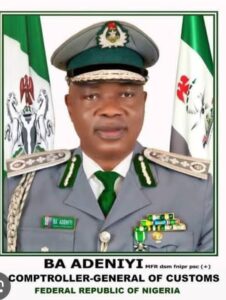
A major stakeholder in the maritime sector, Alhaji Adetona Mubashiru, Chairman and Chief Executive Officer of Only God is Wise Nigeria Limited, has called on the Comptroller-General of the Nigeria Customs Service (NCS) Adewale Adeniyi, to advise the Federal Government to revisit and lift the ban on vehicle importation through the land borders, particularly the Seme border.
Mubashiru, who spoke during a review of the policy, described the ban as one of the most controversial trade policies introduced by previous administrations, stressing that it has negatively affected trade facilitation, revenue generation, and employment opportunities.

He recalled that the ban was announced in a press release dated December 5, 2016, signed by Adewale Adeniyi, who was then the National Public Relations Officer of the Nigeria Customs Service, on behalf of the then Comptroller-General of Customs, Hameed Ali.
According to the statement, the Federal Government banned the importation of both new and used vehicles through Nigeria’s land borders with effect from January 1, 2017, following a presidential directive restricting vehicle imports to seaports only.
Mubashiru noted that the directive generated mixed reactions across the country, with many Nigerians questioning its economic implications.
He explained that the former Customs leadership justified the ban on the grounds that there was no reliable system to monitor vehicle importation through the borders, leading to cases of fake documentation and smuggling.
According to him, the then Customs management also promised that the policy could be reconsidered after the successful implementation of a bilateral electronic connectivity programme between Nigeria and the Republic of Benin.
The initiative, introduced during the tenure of Col. Ali, was designed to automate and share electronic cargo information between both countries to improve transparency in cargo movement and trade monitoring.
Represented at the time by Assistant Comptroller-General in charge of Information and Communication Technology, Benjamin Aber, the former Customs CG expressed optimism that the successful implementation of the interconnectivity system could pave the way for the reopening of land borders for vehicle importation.
However, Mubashiru argued that nearly nine years after the policy took effect, the ban has failed to achieve its intended objectives.

According to him, rather than reducing smuggling, the policy merely diverted vehicle importation activities to illegal bush routes, making enforcement more difficult for Customs officers.
He added that the restriction also contributed to rising vehicle prices, increased inflation, and loss of government revenue, as importers diverted their businesses to neighbouring countries.
“Instead of stopping illegal imports, the ban pushed trade to hundreds of unapproved routes. The Nigeria Customs Service faced serious difficulties policing these illegal channels,” he said.
Mubashiru further maintained that the policy worsened congestion at the nation’s seaports, particularly Lagos ports, while billions of naira in potential import duties were lost to neighbouring countries.
He disagreed with claims by the former Customs management that there were no proper records for vehicles imported through the Seme border before the ban.
According to him, before the exit of former Comptroller-General of Customs, Abdullahi Dikko Inde, Nigeria and the Republic of Benin already had a bilateral agreement guiding the movement of vehicles in transit to Nigeria through the Port of Cotonou.
He explained that under the arrangement, all transit vehicles meant for Nigeria were escorted from Cotonou to the Seme border, where they were officially handed over to Customs officers for proper documentation and clearance.
Mubashiru admitted that the major challenge at the time was inadequate parking space at the border, but noted that the situation has significantly improved.
“At Seme today, there are terminals that can conveniently accommodate more than 1,000 vehicles. The infrastructure has improved, and the environment is now better prepared for proper vehicle processing and clearance,” he stated.
The maritime stakeholder also referenced the position of the National Assembly, particularly the Senate, which had opposed the ban and urged the Nigeria Customs Service to suspend the policy.
He noted that many vehicle dealers in both the new and used automobile markets also criticized the directive, arguing that it primarily favoured a small segment of the auto industry while placing an additional burden on ordinary Nigerians.
Mubashiru therefore appealed to CGC Adeniyi to use his office to encourage the Federal Government to review the policy in the interest of economic growth, employment, and regional trade integration.
Addressing the Customs boss directly, he said “CGC Adewale Adeniyi, you came, you saw and you conquered. Your visits to the Seme border gave many stakeholders hope that the ban on vehicle importation through the land border would eventually be reconsidered.”
He stressed that the policy had adversely affected thousands of youths and artisans whose livelihoods depend on activities surrounding vehicle importation at border communities.
According to him, mechanics, panel beaters, auto electricians, painters, drivers, and other transport-related workers have suffered greatly since the implementation of the ban.
“These are law-abiding Nigerians whose daily survival depends on vehicle-related businesses. The government should reconsider the policy and give these people another opportunity to earn a living,” he added.
—