



By Sandra Chukwunyere
Nigeria’s marine and blue economy sector recorded a remarkable 160 per cent surge in revenue between 2023 and 2025, as agencies under the Federal Ministry of Marine and Blue Economy strengthened governance and operational efficiency. Revenue rose from ₦700.79 billion in 2023 to about ₦1.83 trillion in 2025, according to Minister of Marine and Blue Economy, Adegboyega Oyetola.
Speaking at the 2026 First Quarter Citizens/Stakeholders’ Engagement, Sectoral Performance Review, and Ministerial Management Retreat held on April 2 in Lagos, Oyetola attributed the growth to sweeping reforms focused on accountability, transparency, and operational efficiency.
He said the improvements reflect a deliberate policy shift toward stronger institutional discipline, enhanced regulatory oversight, and digitalisation of operational processes across the sector.
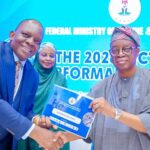
R-L: Minister of Marine and Blue Economy, Dr. Adegboyega Oyetola; Permanent Secretary of the Ministry, Mrs. Fatima Mahmood and the Managing Director of Nigerian Ports Authority, Dr. Abubakar Dantsoho, during the signing of the 2026 performance bonds between the Minister and heads of maritime agencies in Lagos on Thursday.
The minister explained that the revenue growth was driven by improved regulatory monitoring, strengthened revenue assurance systems, and intensified efforts to block financial leakages. He warned heads of agencies to maintain strict accountability, stressing that performance bonds signed during the retreat are binding commitments that will be closely monitored.
- Advertisement -

The retreat also aimed to align policy formulation with implementation and stakeholder expectations, while fostering data-driven decision-making across the sector.
Oyetola disclosed progress toward the refloating of a national shipping carrier, describing it as a major milestone in strengthening Nigeria’s maritime capacity.
He revealed that the Federal Government has secured the interest of global maritime operators, including AD Ports Group and DP World, to collaborate on the initiative. The proposed national carrier is expected to reduce Nigeria’s reliance on foreign shipping lines, retain maritime revenue domestically, and create employment opportunities, complementing other interventions such as the Cabotage Vessel Financing Fund (CVFF).
Addressing concerns over regional imbalance in port development, Oyetola clarified that the government’s port modernisation programme is nationwide. Procurement processes are ongoing for the modernisation of ports in Warri, Port Harcourt, Onne, and Calabar, alongside approved upgrades for Apapa and Tin Can Island ports.
Approvals have also been granted for new deep seaports in Bayelsa, Cross River, Akwa Ibom, and Ondo States, aimed at expanding maritime capacity, opening new economic corridors, stimulating trade, reducing vessel turnaround time, and attracting investment.
In his remarks, Captain Sunday Umoren, Secretary-General of the Abuja Memorandum of Understanding on Port State Control for West and Central African Region, called for stronger collaboration among stakeholders to ensure the effective implementation of Nigeria’s maritime policies and the growth of a sustainable blue economy.
He said the Abuja MoU’s mandate aligns with Nigeria’s maritime policy goals, including compliance with international standards, improved maritime safety, and protection of the marine environment.
Umoren added that stakeholders’ actions or inactions directly influence the performance of the ministry, stressing that every institution must work collectively to achieve policy objectives.
He emphasised that achieving sustainability in the blue economy requires coordination, enforcement, and continuous capacity building among government agencies, industry players, and regional partners.
Also speaking, Greg Ogbeifun, Managing Director of Starzs Marine and Engineering Ltd., called for Nigeria’s urgent return to international shipping, warning that reliance on foreign vessels costs the economy $8–$9 billion annually. He said Nigeria’s lack of indigenous vessels in global trade remains a major structural gap, while regulatory bottlenecks, such as stringent national carrier requirements, continue to hinder local participation. Ogbeifun explained that shipowners are often required to provide full vessel details before being granted national carrier status, despite not having guaranteed cargo to justify acquiring vessels.
Stakeholders at the event, including terminal operators, shipowners, trade associations, and members of the diplomatic corps, commended the ministry’s reforms, describing them as evidence of improving institutional discipline and growing investor confidence in Nigeria’s marine and blue economy.
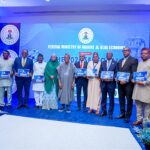
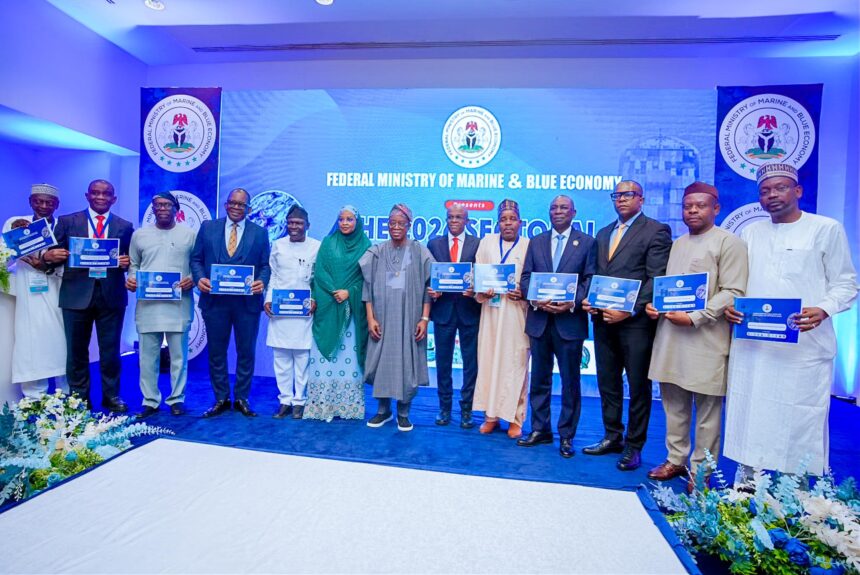
The event also featured the signing of performance bonds between the minister and heads of agencies under the ministry, including the Nigerian Ports Authority, Nigerian Maritime Administration and Safety Agency, Nigerian Shippers’ Council, National Inland Waterways Authority, Maritime Academy of Nigeria, and the Council for the Regulation of Freight Forwarding in Nigeria.
Minister of Marine and Blue Economy, Dr. Adegboyega Oyetola (6th from left), Permanent Secretary of the Ministry, Mrs. Fatima Mahmood (5th from left) and Heads of Government Agencies under the Ministry during the signing of the 2026 performance bonds between the Minister and heads of maritime agencies in Lagos on Thursday.
Newspoints247 reports that experts believe the reforms and port modernisation initiatives will position Nigeria as a leading maritime hub in Africa, encourage indigenous participation in shipping, reduce dependence on foreign shipping lines, and enhance the country’s blue economy competitiveness regionally and globally.