

By Sandra Chukwunyere
The Minister of Marine and Blue Economy, Adegboyega Oyetola, has called for deeper collaboration with the European Union to address emerging maritime threats in the Gulf of Guinea, particularly illegal fishing, trafficking and environmental crimes.
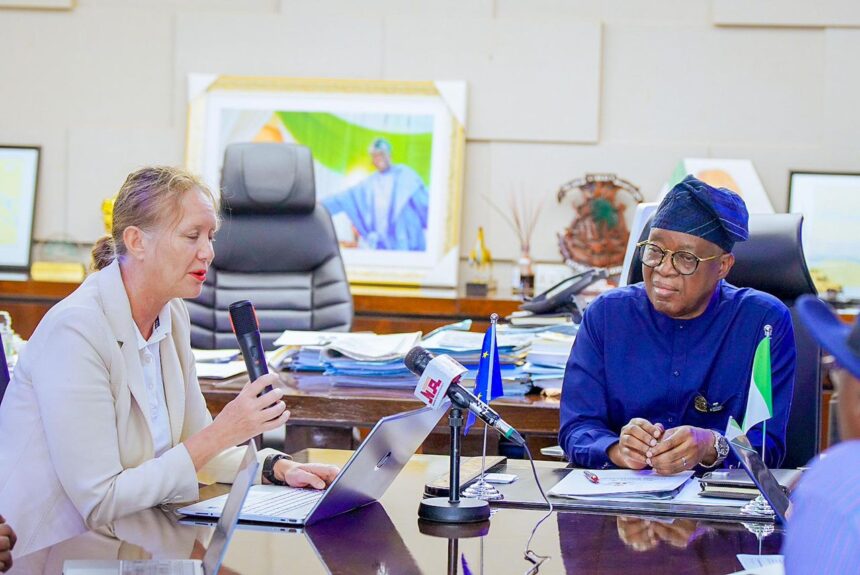
Oyetola made the call on Thursday in Abuja while receiving a delegation from the European Union Evaluation Mission on the Gulf of Guinea Inter-regional Network (GoGIN II) Project.
The delegation, led by Stéphanie Vergniault, is in Nigeria to conduct an independent assessment of the EU-funded initiative designed to strengthen maritime coordination and information sharing across the Gulf of Guinea.
According to a statement signed by the Special Adviser to the Minister on Media and Communications, Bolaji Akinola, the Minister noted that evolving security challenges in the region require a broader, integrated and sustained response anchored on strong international partnerships.
Oyetola reiterated Nigeria’s firm commitment to the Yaoundé Architecture for Maritime Security, describing it as a vital platform for regional cooperation, collective response and intelligence exchange.
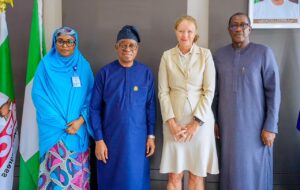
L-R: Permanent Secretary, Federal Ministry of Marine and Blue Economy, Mrs. Fatima Sugra Mahmood; Honourable Minister of Marine and Blue Economy, Dr. Adegboyega Oyetola; Head of the European Union Evaluation Mission on the Gulf of Guinea Inter-regional Network (GoGIN II) Project, Ms Stéphanie Vergniault, and a member of the mission, Captain Alioune Diop, when the EU Evaluation Mission on the GoGIN II Project visited the Minister in his office in Abuja on Thursday.
He said EU-supported interventions such as the Gulf of Guinea Inter‑regional Network II (GoGIN II) have played an important role in strengthening the framework by enhancing maritime domain awareness and promoting collaboration among national and regional agencies.
The Minister also acknowledged the role of the Yaoundé Architecture Regional Information System (YARIS) in improving coordination among maritime stakeholders, stressing the need to sustain and optimise its operational use.
He further highlighted the importance of improving interoperability between regional centres and national institutions, alongside continued capacity building and technical support.
Pointing to Nigeria’s domestic efforts to strengthen maritime security, Oyetola cited the success of the Deep Blue Project, which he said has contributed to a significant reduction in piracy and armed robbery at sea in the Gulf of Guinea in recent years.
According to him, the progress recorded demonstrates the effectiveness of combining national ownership with regional and international support.
As the GoGIN II programme approaches completion, the Minister urged stakeholders to consolidate its achievements and ensure long-term sustainability through stronger regional ownership mechanisms.
Earlier, Vergniault said the evaluation mission aims to assess the programme’s performance, operational results and sustainability while identifying lessons that could guide future maritime security initiatives.
She added that the mission, which also includes Alioune Diop, is engaging key stakeholders in Nigeria to gather operational feedback on the use of the YARIS platform, its contribution to coordination under the Yaoundé Architecture, and challenges within the maritime sector.