






Agreement targets maritime safety, seafarer training, environmental protection, security and capacity development
Bu Sandra Chukwunyere
The Nigerian Maritime Administration and Safety Agency (NIMASA) and the China Maritime Safety Administration (China MSA) have signed a Memorandum of Understanding (MoU) on Maritime Cooperation to strengthen bilateral relations and promote collaboration in the maritime sector of both countries.
The agreement, signed in Shanghai, People’s Republic of China, establishes a framework for cooperation in six key areas, including maritime safety and navigation, marine environmental protection, seafarer training, certification and rights protection, marine casualty and incident investigation, maritime transportation facilitation, and maritime security.
According to a statement signed by Osagie Edward, FNIPR, Deputy Director and Head of Public Relations, NIMASA, the agreement is expected to promote technical cooperation, knowledge-sharing, capacity development and the exchange of best practices between the two maritime administrations.
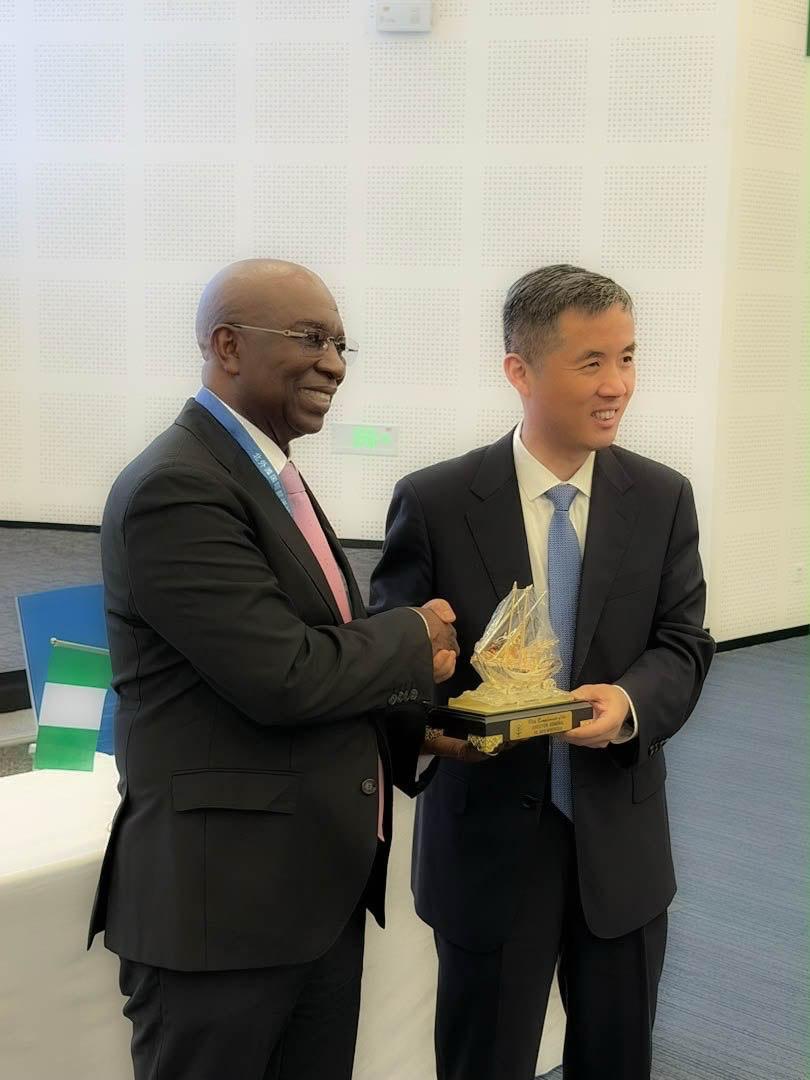
Speaking at the signing ceremony held at the Shanghai Seafarers Assessment Model Centre, the Director-General of NIMASA, Dr. Dayo Mobereola, described the agreement as a historic milestone in the relationship between Nigeria and China.
He emphasised the importance of translating the agreement into practical programmes that would deliver measurable benefits to the maritime industries of both countries.
Mobereola said the MoU represented more than a formal agreement, describing it as a commitment to transforming the longstanding relationship between both countries into practical maritime cooperation and shared expertise.
“This Memorandum of Understanding represents more than a formal agreement; it is a commitment to translate our longstanding relationship into practical maritime cooperation, shared expertise and measurable benefits for both countries. We are determined to ensure that this partnership delivers tangible outcomes for our maritime industries,” he stated.
The NIMASA Director-General also highlighted the commitment of President Bola Ahmed Tinubu to strengthening Nigeria’s bilateral relationship with China, particularly in the maritime sector.
He said the President valued the longstanding relationship between both countries and remained committed to deepening cooperation in line with the Federal Government’s Renewed Hope Agenda.
Mobereola further linked the partnership to the objectives of the Federal Ministry of Marine and Blue Economy under the leadership of the Minister, His Excellency, Adegboyega Oyetola, CON.
He noted that the cooperation would provide opportunities for both countries to share expertise and strengthen institutional capacity in addressing challenges within their respective maritime industries.
On his part, the Director-General of China MSA, Mr. Xu Wei, reaffirmed China’s commitment to strengthening maritime cooperation with Nigeria.
Xu acknowledged China’s interest in Nigeria’s maritime development and commended the progress recorded in the country’s maritime sector.
He also pledged China’s continued support for advancing bilateral collaboration and promoting sustainable growth in the maritime industries of both countries.
The agreement provides a framework for closer institutional engagement between NIMASA and China MSA, particularly in areas requiring technical expertise, professional development and the exchange of operational knowledge.
Through the cooperation framework, both administrations are expected to strengthen their engagement in maritime safety and navigation, environmental protection, seafarer welfare and professional development, casualty investigations, transportation facilitation and maritime security.
The partnership also underscores the importance of international collaboration in developing maritime capacity and promoting sustainable growth within the industry.
The signing of the MoU marks another step in Nigeria-China maritime relations, with both countries expressing their commitment to translating the agreement into practical cooperation and tangible benefits for their maritime sectors.