


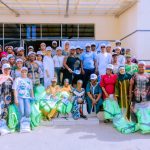



A cheering account of how the Nigeria Customs Service (NCS) decimates smuggling activities along the Nigeria-Benin Republic Border in Idiroko, Ogun State, amid daring moves by the dare-devil criminals to plunder the economy and stem up insecurity, excites the authories, even as stakeholders insist the feat remains a huge support for President Bola Ahmed Tinubu government’s Renewed Hope Agenda
By Innocent Chukwu
At Nigeria’s South-Western border with the Republic of Benin, the battle against smuggling is no longer merely about the interception of bags of rice, petroleum products or second-hand clothing.
Increasingly, it is a battle over the survival of local industries, food security, public health, legitimate trade, national revenue and, ultimately, the economic security of Nigeria.
And at the centre of that battle in recent months has been the Ogun I Area Command of the Nigeria Customs Service, Idiroko, where Deputy Comptroller Olukayode Oladapo Afeni, the Acting Customs Area Controller, has presided over an increasingly aggressive enforcement campaign. Without any gainsaying, the numbers tell part of the story.
The seizure diary under Afeni has moved from drugs and prohibited food products to petroleum products, tyres, pharmaceuticals, clothing, sugar, fertiliser and even antiquities and wildlife.
But perhaps more significant than the sheer volume of seizures is the emerging philosophy behind them: make the border hostile to illicit trade while opening it wider to legitimate commerce.
That philosophy fits into the broader economic direction of President Bola Ahmed Tinubu’s administration, which has consistently presented the Renewed Hope agenda as a programme aimed at strengthening domestic production, protecting investment, improving revenue and securing the country’s economic space.
At Ogun I, those objectives are increasingly being translated into frontline enforcement.
THE AUGUST SCORECARD: ₦3.574 BILLION IN ONE ENFORCEMENT WINDOW
The latest chapter in Afeni’s seizure diary is particularly revealing.
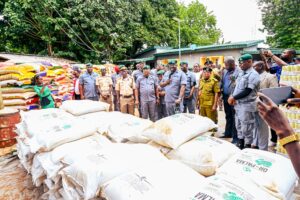
Between June 24 and August 13, 2026, the Ogun I Command intercepted prohibited goods with a combined Duty Paid Value of ₦3,574,435,248.08.
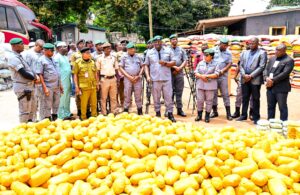
Among the most striking seizures were 6,035 parcels of Ghana Loud/Indica, 2,339 bags of foreign parboiled rice, 70 cartons of basmati rice, 30 bags of foreign sugar, 11,450 litres of Premium Motor Spirit in kegs, another 1,750 litres of PMS in drums and 30 kegs of diesel.
The seizure inventory further included 100 bags of fertiliser, 67 bales of second-hand clothing, 2,674 pieces of new shorts and trousers, 3,760 pieces of new tops, 85 fire extinguishers, 480 cartons of Pure Haven drinks, cosmetics, oats, hair accessories, surgical shoes and 127 new purses.
Yet the cannabis seizure stood out.
The 6,035 parcels of Ghana Loud/Indica were formally handed over to the National Drug Law Enforcement Agency, NDLEA, Idiroko Special Command, for further investigation and necessary action.
Afeni subsequently disclosed that, from January 2026 to the August briefing, the Command had handed over 32,412 parcels of hard drugs and 92 sacks of raw Cannabis Sativa to the NDLEA Idiroko Special Command.
That statistic provides perhaps the clearest indication of the changing character of smuggling through the Ogun border.
It is no longer simply a question of economic contraband.
It is increasingly a question of economic and national security.
BEFORE AUGUST CAME ₦4.63 BILLION
The August seizure did not emerge in isolation.
Between April 1 and June 23, 2026, the Command had recorded 146 seizures with a cumulative DPV of ₦4,628,591,970.16, while generating ₦259,777,346.89 during the same period.
The revenue figure represented a remarkable 238 per cent increase over the ₦76.81 million recorded during the corresponding period of 2025.
That performance is important because it demonstrates that the Command’s story under Afeni has not been exclusively about seizure.
There has also been an attempt to combine enforcement, revenue generation and trade facilitation.
The second-quarter seizure list was extensive: 2,807 bags of foreign parboiled rice, 9,482 parcels of Cannabis Sativa, 62 sacks of raw marijuana, 16,525 litres of PMS, 475 litres of diesel, 7,642 pieces of footwear, 2,427 pneumatic tyres, 63 sacks of foreign sugar, 73 bales of second-hand clothing, fertiliser, imported flour, frozen products and pharmaceuticals.
The Command also handed over 6,981 parcels of Cannabis Indica/Ghanaian Loud and 62 sacks of raw marijuana to the NDLEA, while illicit pharmaceutical products, including 77 cartons of Analgin injections containing 138,600 tubes, were transferred to NAFDAC.

In other words, Afeni’s seizure diary is also becoming a diary of inter-agency enforcement.
THE ₦1.35 BILLION CHAPTER
Earlier, between February and March, the Command intercepted prohibited goods valued at approximately ₦1.35 billion.
That operation produced another revealing catalogue of the commodities moving through the border environment.
They included 2,539 kegs of vegetable oil, 4,325 cartons of foreign spaghetti, 1,204 bags of foreign parboiled rice, 2,547 parcels of Cannabis Sativa and 13,625 litres of PMS.
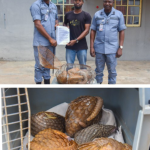
Four live pangolins and two antique artefacts believed to date from the 19th century were also intercepted.
The vegetable oil seizure was also, particularly significant.
Customs described it as part of efforts to protect domestic producers from unfair competition created by smuggled goods.
That is where the anti-smuggling campaign begins to intersect directly with the Renewed Hope economic argument.
For every prohibited consignment that enters Nigeria outside the legal import regime, there is potentially a local manufacturer, farmer, investor or legitimate trader being placed at a disadvantage.
The Customs position is therefore that enforcement is not simply about confiscation.
Rather, it is about protecting the productive economy.
THE RICE WAR
Foreign rice has perhaps become the most visible symbol of the economic contest at the Ogun border.
Again and again, rice appears in Afeni’s seizure diary.
In the April-June enforcement period alone, 2,807 bags of foreign parboiled rice were intercepted.
In the latest June-August operation, another 2,339 bags, alongside 70 cartons of basmati rice, were seized.
Thus far, Afeni’s argument has been straightforward: the illegal inflow of foreign rice undermines local farmers, domestic rice mills and agricultural investors.
That position aligns the border enforcement campaign with the Federal Government’s broader food-security objectives.
The logic is compelling; however one looks at it.
If government policy is encouraging Nigerians to invest in agriculture and local food processing, while smugglers simultaneously flood the market with cheaper prohibited imports, then the border becomes the first point at which that economic policy must be defended.
In this sense, a bag of seized foreign rice is no longer merely a Customs seizure but represents a direct intervention in the competition between illegal imports and domestic production.
WHEN SMUGGLERS FIGHT BACK
Afeni’s seizure diary also records an increasingly dangerous side of the border war.
In one June operation, Customs officers intercepted a truck carrying 113 bags of foreign parboiled rice along the Itori-Wasimi-Abeokuta corridor.
According to the Command, the driver ignored the officers’ signal to stop and attempted to ram the patrol vehicle before he was apprehended.
In another operation, 630 bags of foreign rice were intercepted along the Afamin-Igbogila axis.
Earlier enforcement operations had also involved resistance and attacks on Customs personnel.
This suggests that the enforcement environment around the Ogun border cannot be treated as an ordinary regulatory exercise.
The stakes are evidently high enough for some operators to risk confrontation with armed government personnel.
That is why the Command’s emphasis on intelligence, technology and collaboration with sister agencies becomes important.
FROM PATROLS TO INTELLIGENCE
Perhaps the most important change in the Afeni approach is the apparent movement away from purely reactive patrols towards intelligence-led enforcement.
The August operation, according to Customs, was strengthened by intelligence gathering, technology and collaboration with sister security agencies.
This is significant because border smugglers are themselves adapting.
Their methods increasingly involve concealment, multiple routes, small consignments, night movements, abandoned structures, bush paths and waterways.
The Customs response, therefore, has had to become more sophisticated.
The objective is no longer simply to wait for contraband to appear at a checkpoint.
It is to identify the networks, understand the routes and intercept consignments before they reach the Nigerian market.
That is a different model of border enforcement.
BUT THERE IS ANOTHER SIDE TO THE STORY
Interestingly, while the seizure diary has expanded, so has the Command’s legitimate trade profile.
Between April and June, Ogun I facilitated 20,972 metric tonnes of exports with a Free-On-Board value of ₦1.049 billion — a dramatic improvement over the corresponding period of 2025, when no export activity was recorded.
By the August briefing, the Command reported 10,110 metric tonnes of exports, valued at ₦2.594 billion FOB, with white talc, crushed thermal coal and CNG identified among the major export commodities.
That development deserves attention.
A successful border command cannot simply become a wall.
It must become a filter.
The illegal must be stopped; the legitimate must be facilitated.
And so far, the figures suggests that Ogun I is attempting to pursue both sides of that equation.
THE AFENI EQUATION
The emerging Afeni equation can therefore be reduced to four words: Enforcement. Revenue. Security. Trade.
Let’s break it down.
The enforcement figures are substantial.
The revenue numbers show improvement.
The volume of narcotics handed over to the NDLEA demonstrates the security dimension.
While the rising export statistics point towards the trade-facilitation component, the interconnectedness of all the four is apparent.
One, a secure border encourages legitimate commerce.
Two, legitimate commerce generates revenue.
Three, revenue strengthens government capacity.
And four, strong enforcement protects legitimate operators from unfair competition.
This is the economic-security argument behind the Ogun I experience.
A COMMAND UNDER PRESSURE
Yet the Afeni record should not be romanticized by any means but clearly understood for what it is.
The persistence of large-scale seizures itself demonstrates that the smuggling economy remains alive.
While every seizure is evidence of successful enforcement, it is also evident that somebody is still willing to attempt the illegal movement of the goods.
The continued appearance of rice, petroleum products, narcotics, clothing and other prohibited commodities means that the underlying economic incentives driving smuggling have not disappeared.
Perhaps, this is where the larger policy question arises.
Can enforcement alone permanently defeat smuggling?
Probably not.
Border communities need legitimate economic alternatives.
Traders need predictable procedures.
Exporters need efficient processing.
Security agencies need sustained inter-agency cooperation.
And the Customs Service must continue to ensure that legitimate trade is not inadvertently caught in an enforcement net designed for criminal networks.
Afeni’s challenge, therefore, is bigger than producing impressive seizure statistics.
It is to help transform Idiroko from a border corridor defined by illicit commerce into a gateway for legitimate Nigerian production and exports.
THE RENEWED HOPE TEST
The real test of the Renewed Hope agenda at the border is not how many bags of rice Customs can seize.
It is whether the seizures ultimately contribute to a market environment in which Nigerian farmers can produce competitively, local manufacturers can survive, legitimate traders can operate profitably, government can collect its lawful revenue and criminal networks can no longer exploit the border as an economic highway.
By that measure, Afeni’s diary offers an interesting case study.
From the ₦1.35 billion seizure chapter of February-March, to the ₦4.63 billion recorded between April and June, and then the ₦3.574 billion seizure window stretching from June 24 to August 13, the operational tempo has remained high.
And behind those numbers is an increasingly diversified enforcement portfolio: drugs, rice, petroleum products, vegetable oil, tyres, pharmaceuticals, clothing, sugar, fertiliser, wildlife and antiquities.
More importantly, the Command has coupled seizures with drug handovers, inter-agency operations, revenue collection and legitimate export facilitation.
That may ultimately prove more significant than any single seizure.
THE DIARY CONTINUES
As August 2026 closes, one conclusion appears difficult to dispute:
The Ogun I border is no longer being treated as merely a Customs collection point.
It is increasingly being managed as an economic-security theatre.
For smugglers, the apparent message from Idiroko is unmistakable: the routes are being watched, the networks are being pursued and the cargoes are increasingly vulnerable to interception.
For legitimate businesses, however, there is another message: the border is expected to become a safer and more predictable channel for lawful commerce.
And for the Tinubu administration’s Renewed Hope agenda, that distinction is critical.
Because the ultimate measure of success is not the size of the seizure warehouse.
It is the size of the legitimate economy that emerges when the smuggling economy is squeezed out.
For now, Afeni’s seizure diary is still being written, and at Idiroko, the pages are filling up fast.