







By Sandra Chukwunyere
For years, the Idiroko border corridor in Ogun State has carried two very different identities.
On one hand, it is an important commercial route linking communities and businesses around the Nigeria-Benin border. On the other, it has remained a preferred route for smugglers looking to exploit the difficult terrain, price differences and gaps in enforcement along the frontier.
That balance, however, appears to be changing.
At the heart of the emerging shift is the Ogun I Area Command of the Nigeria Customs Service, under the leadership of the Acting Customs Area Controller, Deputy Comptroller Olukayode Afeni.
Since assuming responsibility for the Command, Afeni has placed considerable emphasis on intelligence gathering, coordinated operations and sustained enforcement, with the clear objective of making illicit trade increasingly difficult while protecting legitimate commerce.
The latest seizures announced by the Command provide a glimpse into the scale of the operation.
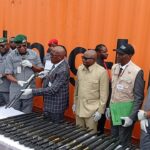
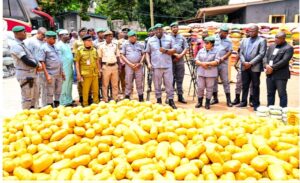
The Command said it intercepted smuggled goods with a combined Duty Paid Value of N3.574 billion. The seizures covered a wide range of commodities, including foreign parboiled rice, basmati rice, petroleum products, fertilizer, second-hand clothing, consumer goods and narcotics.

Among the items seized were 2,339 bags of foreign parboiled rice, 70 cartons of basmati rice, 6,035 parcels of Ghana Loud/Indica, 30 bags of foreign sugar, 11,450 litres of PMS packed in kegs, 1,750 litres of PMS in drums, 30 kegs of diesel, 100 bags of fertilizer and 67 bales of second-hand clothing.
There were also thousands of pieces of clothing and other consumer products, including drinks, cosmetics, hair accessories, fire extinguishers and purses.
But beyond the impressive figures lies a more important story.
The seizures show the wide range of economic activities taking place around the border and the growing effort by Customs to disrupt the networks that move prohibited or improperly imported goods into the country.
Changing the economics of smuggling
Smuggling survives when the potential profit is considered greater than the risk of being caught.
That is the calculation Afeni appears determined to change.

Every intercepted vehicle, truck, petroleum consignment, rice shipment or narcotics parcel represents more than a seizure. It represents a disruption to a supply chain and a financial setback for those involved in the illegal trade.
The strategy is therefore not simply about taking goods off the road. It is about making smuggling less predictable and less profitable.
Afeni has repeatedly warned that Ogun I will become increasingly hostile to smugglers.
For operators who have depended on the corridor for years, that warning carries an economic implication: the cost of doing business illegally is rising.
The rice question
Foreign parboiled rice remains one of the major commodities confronting Customs officers along the Idiroko corridor.
The seizure of more than 2,300 bags in the latest operation again highlights the continuing challenge posed by illicit rice imports.
The issue goes beyond Customs regulations.
Nigeria has invested heavily in improving domestic agricultural production, particularly rice farming and processing. When foreign rice enters the country through unofficial channels, it competes with locally produced rice without passing through the same regulatory and fiscal processes.
For farmers, millers and legitimate distributors, that can affect prices, investment decisions and ultimately the viability of the domestic value chain.
This makes the fight against rice smuggling part of a wider economic policy conversation.
At Idiroko, Customs enforcement is therefore not only about stopping prohibited imports. It is also about protecting the market for legitimate Nigerian production.
The darker side of the border
The narcotics seizures bring an even more serious dimension to the border challenge.
The Command intercepted 6,035 parcels of Ghana Loud/Indica during the latest operation. Afeni also disclosed that, from January to date, Ogun I had handed over 32,412 parcels of hard drugs and 92 sacks of raw Cannabis sativa to the NDLEA Idiroko Special Command.
Those figures underline the security implications of the border corridor.
Customs may be the agency that intercepts a shipment, but the fight against drug trafficking cannot end with a seizure. Drug intelligence, investigation, prosecution and rehabilitation require the specialised involvement of agencies such as the National Drug Law Enforcement Agency.
The handover of the seized narcotics to the NDLEA therefore demonstrates the importance of agencies working together rather than operating in isolation.
For a border corridor as complex as Idiroko, collaboration is becoming as important as enforcement itself.
Idiroko is more than an import route
There is another part of the Ogun I story that deserves greater attention.
The Command recorded 10,110 metric tonnes of exports with a Free On Board value of N2.594 billion.
White talc, crushed thermal coal and compressed natural gas were identified among the major contributors to the export figures.
That performance challenges the long-standing perception of Idiroko mainly as a route through which foreign goods enter Nigeria.
The corridor can also serve as a channel for Nigerian products to reach international markets.
That distinction is important.
Effective border management should not mean shutting down cross-border commerce. Rather, it should create a system in which legitimate businesses can trade with greater confidence while illegal operators face increasing difficulty.
That is where trade facilitation and enforcement must meet.
The revenue side
The border also contributes to government revenue through several channels.
In July alone, Ogun I collected N90.066 million from baggage assessments, auctions of perishable goods, PMS-related collections and other charges.
The amount may appear small compared with the billions generated by Nigeria’s major seaport commands, but it reflects the diverse economic activities taking place around the border.
It also reinforces the fact that the economic relevance of Idiroko cannot be measured solely by the value of seized goods.
There is a legitimate economy operating alongside the illicit one.
Protecting legitimate traders
This is perhaps the most important test facing the current enforcement campaign.
Idiroko is home to legitimate traders, transporters, farmers, manufacturers, exporters and other businesses whose livelihoods depend on cross-border commerce.
They should not be made to pay the price for the activities of smugglers.
This means that as enforcement becomes tougher, Customs procedures for compliant traders must also become clearer, faster and more predictable.
A successful border strategy should ultimately produce two different experiences.
For legitimate businesses, there should be greater certainty and easier access to lawful trade.
For smugglers, there should be greater uncertainty, higher risks and lower profits.
That is the balance that will determine whether the current campaign produces a lasting economic impact.
A battle over the future of Idiroko
The figures emerging from Ogun I suggest that something bigger than a series of seizures is taking place.
It is a contest over what kind of commercial environment Idiroko will become.
Will it remain a corridor where illicit operators exploit the border for quick profits, or can it develop into a more organised gateway for legitimate Nigerian trade?
Afeni’s approach suggests that the Command intends to push the corridor firmly in the second direction.
The seizures of rice and petroleum products speak to economic protection. The narcotics interceptions highlight the security dimension. The export figures reveal the corridor’s commercial potential, while the revenue collections demonstrate its fiscal importance.
But enforcement alone will not determine the outcome.
Sustained intelligence gathering, modern border infrastructure, efficient Customs procedures, stronger inter-agency cooperation and the support of border communities will all be necessary.
For now, however, the message from Ogun I is clear.
The objective is not to stop trade at Idiroko.
It is to change the rules of the game—protect legitimate commerce, disrupt illicit supply chains and make smuggling increasingly difficult to sustain.
If that approach can be maintained over time, Afeni’s tenure may ultimately be remembered not simply for the seizures recorded under his watch, but for helping to change the economic dynamics of one of Nigeria’s most important border corridors.