







By Sandra Chukwunyere
The National Assembly (NASS) on Wednesday dismissed three petitions challenging the pipeline surveillance contract and passed a vote of confidence on Tantita Security Services, security agencies, and the Nigerian National Petroleum Company Limited (NNPCL) for their roles in protecting Nigeria’s oil assets and boosting crude oil production.
The endorsement comes as Nigeria’s oil output rises to about 1.8 million barrels per day (mbpd) as of April, up from around 900,000 barrels per day recorded in 2022 when the surveillance contract was introduced.

The resolution followed a motion moved by the Chairman of the House Committee on Petroleum Resources (Midstream), Henry Okojie, during a one-day parliamentary roundtable on pipeline security and efforts to curb crude oil theft.
The joint committees on Petroleum Resources said the surveillance arrangement has significantly reduced pipeline vandalism, curtailed crude oil theft, and increased national revenue. They noted that the initiative has been instrumental in securing critical oil infrastructure, with Tantita and security agencies making measurable progress in safeguarding pipelines and other oil facilities.
Okojie emphasized that the collaboration between private security firms, host communities, and government security agencies has helped dismantle several illegal tapping points, improved production levels, and enhanced the delivery of crude to export terminals.
Speaking at the event, the Speaker of the House of Representatives, Abbas Tajudeen, stressed the need for sustained efforts to secure Nigeria’s oil sector amid growing global energy uncertainty.
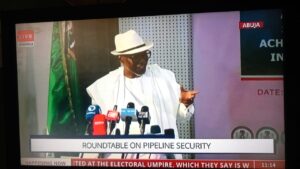
He pointed to geopolitical tensions, including the Middle East crisis and the Russia-Ukraine conflict, as factors contributing to volatility in global energy markets, noting that crude oil remains a dominant energy source, particularly in the transportation sector.
Tajudeen explained that the pipeline surveillance contract became necessary due to long-standing challenges in the Niger Delta, where weak enforcement, agitation, and economic hardship fueled pipeline vandalism, crude oil theft, and illegal refining.
According to him, Nigeria was at one point losing between 10 and 30 percent of its crude oil production to theft, costing the country billions of dollars annually and undermining its credibility as a reliable oil producer.
He said the Federal Government’s decision to engage private security firms and host communities was aimed at strengthening the protection of oil facilities, stressing that community participation has proven critical to the success recorded so far.

Tajudeen also highlighted the social impact of the initiative, noting that it has created jobs for thousands of youths in the Niger Delta, many of whom were previously involved in agitation and illegal activities.
Despite the progress, he acknowledged that challenges remain, particularly in the areas of transparency, accountability, and the effectiveness of certain surveillance frameworks.
He reaffirmed the National Assembly’s commitment to reforming the oil sector through legislation, oversight, and funding support. Tajudeen cited the Petroleum Production and Distribution (Anti-Sabotage) Act and the Petroleum Industry Act (PIA) as key legal frameworks that introduced stricter penalties for vandalism and enhanced community participation.
He explained that under the PIA, host communities risk losing benefits if vandalism occurs within their areas, thereby promoting a sense of shared responsibility in protecting oil infrastructure.
Tajudeen added that the 10th National Assembly has intensified oversight on the implementation of the PIA, conducted investigative hearings on oil theft, and approved funding for pipeline security.
He stressed that crude oil theft should be treated not only as an economic crime but also as a national security threat requiring coordinated action.
The Speaker described the roundtable as an opportunity to consolidate gains from the surveillance contract, address existing gaps, and strengthen transparency, accountability, and community engagement in protecting Nigeria’s oil assets.
Stakeholders at the roundtable also commended the collaboration between Tantita Security Services, security agencies, and host communities, noting that the partnership has strengthened surveillance across key oil facilities in the Niger Delta and contributed to improved crude production.
They urged the Federal Government to sustain the initiative while enhancing transparency and accountability mechanisms to consolidate the gains recorded in the fight against crude oil theft.

- NASS
“We must position Nigeria as a reliable energy supplier in the global market,” Tajudeen said. “The world is searching for energy security, and Nigeria must present itself as a credible alternative. We cannot afford internal sabotage. Our message is clear: Nigeria is securing its assets, stabilizing production, and remains open for business.”