





By Sandra Chukwunyere
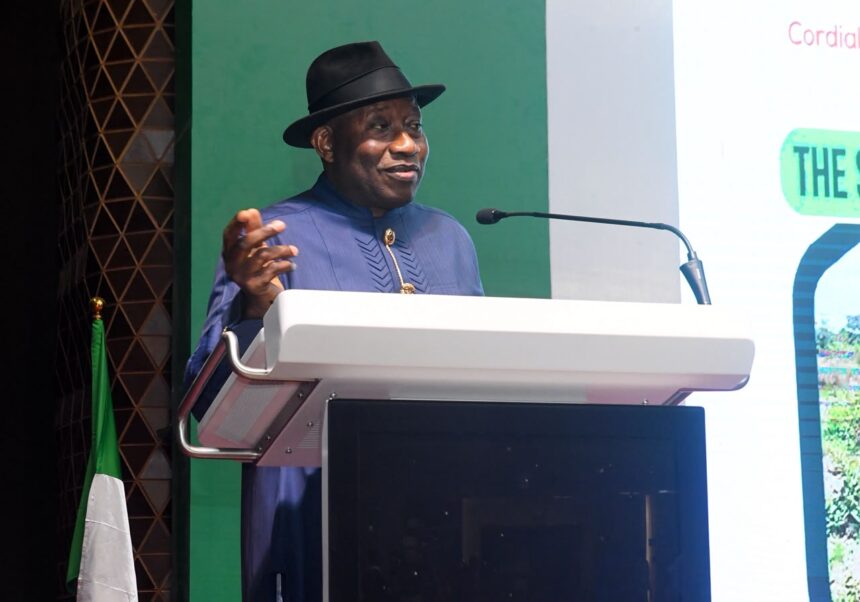
Former President Goodluck Jonathan has credited China’s rapid industrial growth for inspiring Nigeria’s local content policy, describing the establishment of the Nigerian Content Development and Monitoring Board (NCDMB) as one of the most rewarding achievements of his administration.
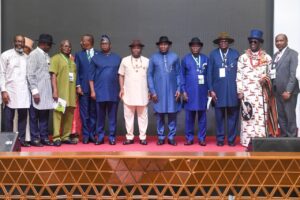
Speaking at the SweetCrude Dialogue 2026 held at the Nigerian Content Tower in Yenagoa, Bayelsa State, Jonathan said his decision to sign the Nigerian Oil and Gas Industry Content Development (NOGICD) Act into law in April 2010 was driven by a desire to ensure that Nigerians played a greater role in the country’s oil and gas industry.

The dialogue, themed “Through the Python’s Eye: 70 Years of Oil and Gas Production,” attracted key stakeholders, policymakers, industry experts and academics who examined the evolution of Nigeria’s petroleum sector and its future prospects.
Jonathan recalled that during a visit to China while serving as Deputy Governor of Bayelsa State, he observed that almost every product and service used in the country’s oil industry was sourced locally.
He said the experience left him wondering why Nigeria, despite discovering crude oil around the same period as China, continued to depend heavily on foreign technology, equipment and expertise.
According to him, the disparity convinced him that Nigeria needed a legal framework that would promote indigenous participation, develop local capacity and retain more value within the nation’s economy.
The former president applauded the NCDMB for remaining faithful to the vision of the Act and for recording significant achievements in developing local capacity over the years. He also commended the organisers of the dialogue, De Mangrove Conversations, for creating a platform to discuss critical issues affecting the oil and gas industry.
He stressed the need to sustain conversations on host community development, environmental sustainability and the effective implementation of the Petroleum Industry Act (PIA) to ensure long-term growth in the sector.
Representing the Executive Secretary of the NCDMB, Engr. Felix Omatsola Ogbe, the Board’s Director of Monitoring and Evaluation, Barr. Esueme Dan Kikile, said Nigeria’s local content performance has grown from less than five per cent in 2010 to 61 per cent in 2026.
He attributed the progress to deliberate policies aimed at strengthening indigenous participation, developing local skills and ensuring greater retention of industry value within the country.
Kikile said the Board’s Human Capacity Development Initiative has enabled thousands of Nigerians, including engineers, geologists, technicians and seafarers, to acquire industry-relevant skills through specialised training and professional certification programmes.
He also highlighted several strategic projects executed by the Board, including the Nigerian Content Tower, the Oloibiri Museum and Research Centre, the Nigerian Oil and Gas Parks in Bayelsa and Cross River states, gas infrastructure projects in Bayelsa, the Brass Shipyard initiative and the Back-to-the-Creek programme, which focuses on bringing development directly to oil-producing communities.
According to him, these investments are helping to transform Bayelsa from the birthplace of Nigeria’s oil industry into a centre for industrialisation, technology development and value creation.
Bayelsa State Governor Douye Diri, represented by Deputy Governor Dr. Peter Akpe, described Bayelsa as the most appropriate venue for commemorating 70 years of oil production in Nigeria, noting that the state’s place in the country’s petroleum history makes it central to discussions on the future of the industry.
Also speaking, Delta State Governor Sheriff Oborevwori, represented by his Chief of Staff, Prince Johnson Erijo, urged government and industry leaders to deepen their commitment to the welfare and development of host communities.
Representing the Managing Director of the Niger Delta Development Commission (NDDC), Chief of Staff Julius Oworibo said the dialogue offered stakeholders an opportunity to reflect on the achievements of the oil-producing region while charting a more sustainable path for the future.
In his keynote address, Professor Ibibia Lucky Worika of Rivers State University observed that while oil has driven Nigeria’s economy, politics and global relevance for seven decades, the Niger Delta has borne the greatest environmental and social costs.
He maintained that environmental justice must remain a priority, describing it as a constitutional, moral and developmental imperative.
Earlier, Convener of De Mangrove Conversations, Biobele Da-Wariboko, said the initiative was created to preserve the history and contributions of the Niger Delta and ensure that its role in Nigeria’s development is neither forgotten nor overlooked.