






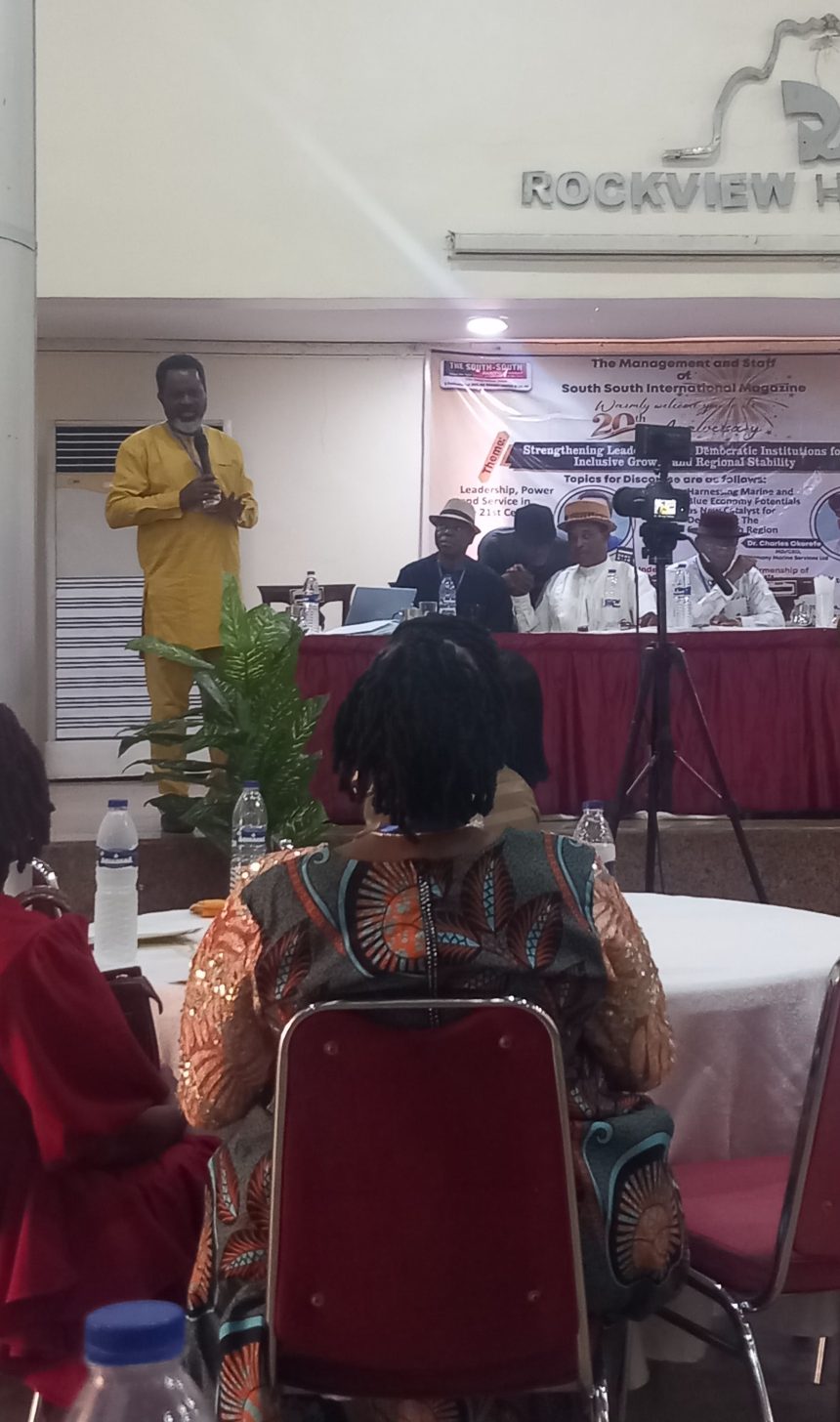
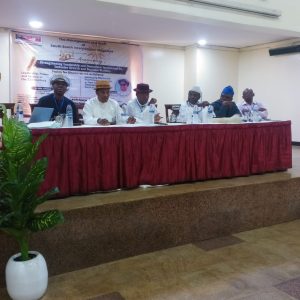
At the South-South International Magazine’s 20th anniversary public lecture in Lagos, Johnson says elections alone cannot guarantee good governance, while Dr. Charles Okorefe urges South-South governors to harness the region’s marine and Blue Economy potential for economic growth.
By Sandra Chukwunyere
The Chief Lecturer of the Nigerian Institute of Journalism (NIJ), Ogba, Lagos, Jide Johnson, PhD, has challenged political leaders to embrace accountable leadership, constitutional responsibility and people-centred governance, stressing that elections alone cannot guarantee effective democracy or improve citizens’ welfare.
Johnson made the call while delivering a public lecture titled *“Leadership, Power and Service in the 21st Century”* at the 20th anniversary public lecture of South-South International Magazine, held at Rockview Hotel, Apapa, Lagos, on November 18, 2026.
He argued that the legitimacy and sustainability of democratic governance depend not only on who holds political power but also on how leaders exercise it and translate it into public service.
Johnson noted that although Nigeria has operated under civilian constitutional rule since 1999, periodic elections alone cannot guarantee accountable institutions, effective public services or citizens’ confidence in government.
Explaining the relationship between leadership, power and service, he said leadership involves providing vision, formulating policies and mobilising resources for the benefit of society.
He described power as the legitimate authority to make decisions, allocate resources and enforce laws, while service represents the responsibility to use public authority and resources to protect citizens’ security and welfare.
He warned that power without leadership could become arbitrary, while leadership and power without service could result in domination and oppression.
Citing Sections 14(2)(a) and 14(2)(b) of the 1999 Constitution, Johnson stressed that sovereignty belongs to the Nigerian people and that their security and welfare remain the primary purpose of government.
He maintained that public officials and government institutions exist to serve citizens, adding that public office should be regarded as a position of trust rather than private property or family inheritance.
The NIJ Chief Lecturer also examined transformational leadership, associated with James MacGregor Burns and Bernard Bass; servant leadership, developed by Robert Greenleaf; and democratic leadership, which emphasises citizens’ participation.
He explained that transformational leadership requires genuine institutional reforms, servant leadership demands commitment to the people’s needs, while democratic leadership promotes respect for citizens’ rights, established procedures and diverse opinions.
He also referred to Max Weber’s classification of authority into traditional, charismatic and legal-rational forms.
Johnson urged Nigeria to move beyond personality-centred leadership towards predictable, impartial and law-governed institutions.
He distinguished traditional state-centred governance from contemporary governance, which involves collaboration among government, citizens, businesses and civil society organisations.
According to him, transparency, accountability and public value should guide government performance, while political leaders must build inclusive and effective institutions capable of delivering tangible benefits to citizens.
He concluded that leadership actions must be legitimate, inclusive, effective and beneficial to all, insisting that public officeholders must serve the collective good rather than personal or sectional interests.
Also speaking at the anniversary lecture, the Managing Director and Chief Executive Officer of Kamany Services Limited, Dr. Charles Okorefe, urged governors in the South-South region to harness its marine and Blue Economy potentials as alternative drivers of economic growth, employment generation and sustainable development.
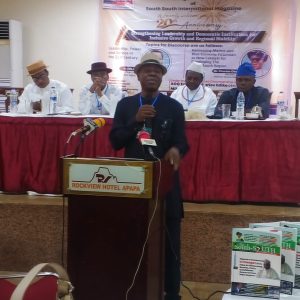
Okorefe made the call while presenting a paper titled *“Harnessing Marine and Blue Economy Potentials as New Catalyst for Developing the South-South Region of Nigeria.
He described the Blue Economy as a development model that promotes the sustainable use of marine and coastal resources while protecting aquatic ecosystems and creating economic opportunities.
He explained that the concept covers economic activities connected with oceans, seas, coastal areas, rivers and lakes, including fisheries and aquaculture, tourism, maritime transportation, shipping, port operations, renewable energy and marine biotechnology.
Tracing the evolution of the concept, Okorefe referred to the work of Belgian scholar and entrepreneur Gunter Pauli and highlighted the 2012 United Nations Conference on Sustainable Development, popularly known as Rio+20, and its outcome document, *“The Future We Want.”*
He also linked the Blue Economy to the Sustainable Development Goals, particularly Goal 14, which focuses on conserving and sustainably using oceans, seas and marine resources.
Reflecting on the Niger Delta’s history, he recalled the region’s early commercial importance, including the activities of the Royal Niger Company and foreign commercial interests such as the United Africa Company, John Holt, Unilever and G.B. Ollivant between 1879 and 1886.
He also highlighted the historical importance of coastal trading centres and harbours in Calabar, Opobo, Brass, Burutu and Warri, as well as the establishment of Southern Nigeria Marine in 1906.
Okorefe traced the development of the modern oil industry in the region to the discovery of commercial crude oil at Oloibiri in 1956, with production and export activities commencing in 1958.
However, he observed that oil exploration and production have contributed to environmental degradation, communal tensions and conflicts in the Niger Delta.
He argued that the region must diversify beyond crude oil by investing in fisheries and aquaculture, marine biotechnology, renewable energy, coastal tourism, dredging, marine support services, port development, ship recycling and inland waterways transportation.
Other areas he identified for investment include maritime safety, marine insurance and shoreline protection.
Okorefe identified low public awareness, marine pollution, weak governance, inadequate investment, exclusion of local communities, overfishing, climate change, rising sea levels and research limitations as major challenges to developing the Blue Economy.
To address these challenges, he called for public enlightenment, professional training, improved waste management, pollution control, stronger legal frameworks and integrated ocean governance.
He also advocated community participation, support for small-scale fish merchants and mangrove conservation groups, sustainable fishing practices, climate adaptation and increased investment in marine technology and renewable energy.
The speaker urged South-South governors to develop a regional Blue Economy investment blueprint, invest in human capital and create an enabling environment for private-sector participation.
He recommended public-private partnerships and the use of Blue Bonds to finance the protection of mangroves, coral reefs and marine protected areas, citing Seychelles’ $15 million Blue Bond initiative as an example.
Other proposals included the development of aquaculture and fish-port clusters, a regional climate strategy, marine-based power generation and an integrated transport blueprint linking roads, railways, inland waterways and pipelines.
He further called for stronger export capacity through value addition, modern infrastructure and efficient logistics, urging governments to collaborate with investors and local communities to unlock the region’s marine and coastal economic potential.

Okorefe expressed optimism that greater commitment by federal and regional governments to the Blue Economy would stimulate economic growth, create employment opportunities and promote sustainable development across the South-South region.