





By Sandra Chukwunyere
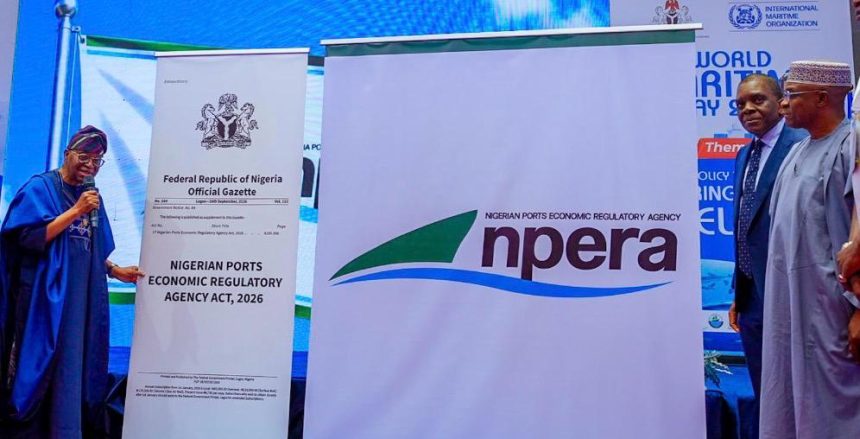
The Minister of Marine and Blue Economy, Dr Adegboyega Oyetola, has unveiled the gazetted Nigeria Ports Economic Regulatory Agency (NPERA) Act, 2026, alongside the agency’s official logo, reaffirming the Federal Government’s commitment to strengthening port regulation, improving operational efficiency and enhancing Nigeria’s maritime competitiveness.
Oyetola made the announcement on Friday at the Third Quarter 2026 Citizens’ and Stakeholders’ Engagement of the Federal Ministry of Marine and Blue Economy, held in Victoria Island, Lagos.
The engagement, themed “Building Strategic Bilateral Partnerships for Sustainable Growth, Investment, and Technology of Nigeria’s Marine and Blue Economy,” brought together government officials, industry leaders, development partners and other stakeholders to discuss investment opportunities and ongoing reforms in the marine and blue economy sector.
The minister said the enactment of the NPERA Act, following President Bola Ahmed Tinubu’s assent in June 2026, marked a significant milestone in the establishment of a statutory framework for port economic regulation after nearly two decades of efforts.
He disclosed that he had directed the immediate constitution of a ministerial committee to oversee the transition of the Nigerian Shippers’ Council, which has served as the interim port economic regulator since 2014, into the new agency.
According to Oyetola, NPERA will regulate port tariffs and charges, promote competition, enforce service standards, resolve commercial disputes and protect the interests of port users.
“The credibility of an economic regulator rests, in no small measure, on its independence, impartiality and freedom from responsibilities that could give rise to actual or perceived conflicts of interest,” he said.
He stressed that the new agency must operate as an impartial regulator, free from competing regulatory and operational responsibilities, to ensure transparency, fairness and accountability in the port system.
On port infrastructure, Oyetola highlighted plans to modernise Apapa, Tin Can Island, Onne, Rivers, Delta and Calabar ports, stating that the programme was designed to promote balanced development across Nigeria’s maritime gateways.
“No part of our national port system will be left behind in this modernisation programme,” he declared, adding that ports outside Lagos remained vital to the country’s economic future.
The minister also disclosed that the Federal Government had approved the development of the Ibom, Bakassi, Agge, Gateway, Ondo and Bonny Deep Seaports as part of efforts to expand maritime capacity, attract investment and position Nigeria as a regional logistics hub.
On maritime security, Oyetola said Nigeria had maintained zero piracy incidents in its territorial waters through the Deep Blue Project.
He described the lifting of the 12-year United States Coast Guard Condition of Entry on vessels arriving from Nigeria in August 2026 as a major achievement, noting that it reflected progress in maritime security and compliance with the International Ship and Port Facility Security (ISPS) Code.
Oyetola further reaffirmed the government’s commitment to strengthening indigenous shipping, disclosing that he had directed the Nigerian Maritime Administration and Safety Agency (NIMASA) to work with approved Primary Lending Institutions to accelerate the processing and disbursement of the Cabotage Vessel Financing Fund (CVFF) to qualified applicants.
He said access to the fund would support indigenous operators and strengthen local capacity in Nigeria’s maritime industry.
Highlighting the importance of international cooperation, the minister cited Nigeria’s election to Category C of the International Maritime Organization (IMO) Council in November 2025 and ongoing engagements with Denmark, India, Norway and the United Kingdom.
“Our approach to international cooperation is purposeful and results-oriented,” he said, stressing that partnerships must strengthen local capabilities and deliver measurable, sustainable outcomes.
As part of the engagement, the Ambassador of the Kingdom of Denmark to Nigeria, Jens Ole Bach Hansen, delivered a presentation titled “Denmark’s Experience in Building a Sustainable Blue Economy: Lessons for Strategic Partnerships, Investment and Technology Transfer with Nigeria.”
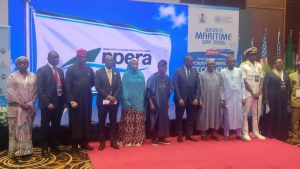
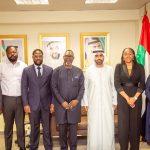
L-R: Deputy Chairman, House Committee on Maritime Safety, Education and Administration, Hon. Odudoh Uduak; Chairman, Senate Committee on Marine Transport, Senator Wasiu Eshinlokun; Minister of Marine and Blue Economy, Dr. Adegboyega Oyetola; Permanent Secretary, Federal Ministry of Marine and Blue Economy, Mrs Fatima Mahmood and Director General, Nigerian Maritime Administration and Safety Agency (NIMASA), Dr. Dayo Mobereola and other stakeholders at the 2026 World Maritime Day in Lagos, on Friday.
The presentation examined Denmark’s experience in developing a sustainable blue economy and highlighted opportunities for Nigeria to strengthen bilateral partnerships in investment, technology transfer and maritime development.