




By Sandra Chukwunyere
The National Single Window (NSW) Secretariat has set a target of reducing cargo clearance time in Nigeria to 24 hours, from the current average of two to three weeks, as maritime stakeholders called for smarter ports, greener logistics and stronger coordination among regulatory agencies.
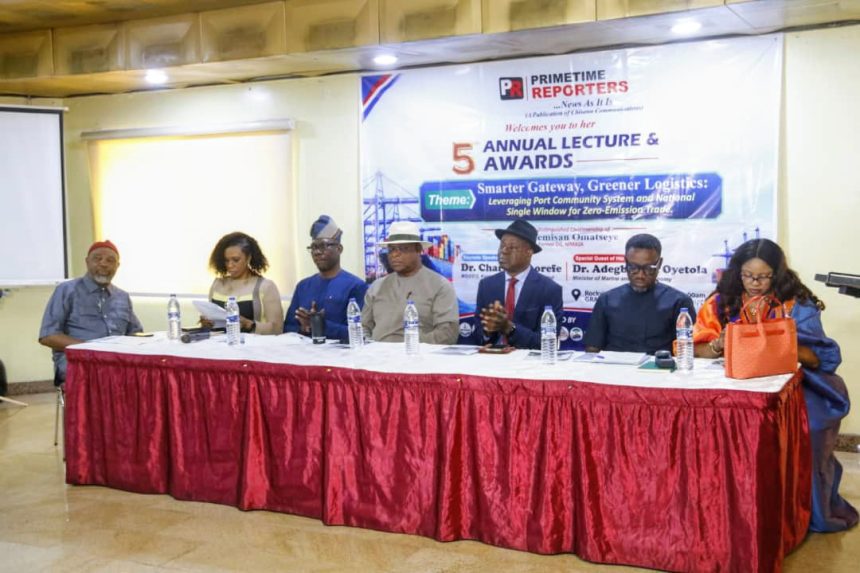
The National Coordinator of the NSW Secretariat, Mr. Tola Fakolade, disclosed this at the 5th Annual Lecture and Awards organised by Primetime Reporters at Rockview Hotels, GRA, Apapa, Lagos, on Thursday.
Fakolade, who was represented by the Secretariat’s Deputy Director, Mr. Jude Oboh, said the initiative was designed to simplify trade procedures, reduce cargo dwell time, eliminate unnecessary physical examinations and lower the cost of doing business in Nigeria.
He explained that the Federal Government had directed that cargo clearance for both imports and exports should be reduced to one day, noting that prolonged clearance procedures remained a major contributor to the high cost of trade.
According to him, the National Single Window would achieve this through a centralised digital platform that enables importers and exporters to submit trade documentation once, allowing relevant government agencies to access the information without repeatedly requesting the same documents.
He added that the platform would enhance transparency, strengthen risk management and enable regulatory agencies to identify compliant traders for faster processing while subjecting high-risk consignments to closer scrutiny.
Fakolade expressed concern that approximately 95 per cent of cargo in Nigeria was subjected to intrusive physical examination, describing the practice as excessive. He said the Secretariat aimed to reduce the proportion to below 10 per cent, in line with international best practices.
He attributed the high rate of physical examinations partly to the absence of a centralised risk management system and overlapping responsibilities among regulatory agencies operating at the ports.
The NSW, he said, would promote information-sharing and coordinated risk assessment among agencies, thereby reducing unnecessary inspections and accelerating cargo release.
He added that the Federal Government had also directed that Nigeria’s cargo clearance costs should, at worst, be comparable to those of other West African countries, amid concerns that some cargo destined for Nigeria had been diverted to competing regional ports.
Providing an update on implementation, Fakolade disclosed that the platform had issued more than 156,000 licences and permits within six months, reducing the need for applicants to visit multiple government agencies physically.
He said more than 12,000 importers and clearing agents had registered on the platform, while five ministries, departments and agencies were already using the system.
According to him, the first phase, which focuses on non-oil imports, had commenced with the integration of pre-shipment documentation and permits issued by relevant regulatory agencies.
He explained that importers could now apply for applicable licences and permits through the platform, while shipping manifests submitted by shipping lines and airlines were also being channelled electronically to the relevant authorities.
Fakolade said the Secretariat was preparing to extend the initiative to exports, with operations expected to commence by the end of the fourth quarter of 2026, subject to the implementation schedule.
The third phase, he added, would cover the oil and gas sector and trade visualisation solutions to provide greater visibility into Nigeria’s trade activities.
He urged freight forwarders, shipping companies and other maritime stakeholders to continue providing feedback to improve the platform’s efficiency and effectiveness.
## Okorefe advocates technology-driven, greener ports
Delivering the keynote address, former lecturer at the Nigerian Maritime University, Okerenkoko, Delta State, and Managing Director/Chief Executive Officer of Kamany Marine Services Limited, Dr. Charles Okorefe, said Nigeria had considerable ground to cover in developing technologically advanced and environmentally sustainable ports.
Speaking on the theme, *“Smarter Gateways, Greener Logistics: Leveraging Port Community System and National Single Window for Seamless Trade Flows,”* Okorefe described ports as critical gateways for international commerce, stressing that efficiency must extend beyond vessel reception and cargo clearance to the seamless movement of goods.
He explained that smart ports deploy technologies such as artificial intelligence, the Internet of Things, big data, blockchain and automation to improve cargo handling, reduce energy consumption, minimise delays and lower operating costs.
According to him, these technologies could improve vessel scheduling, automate cargo-handling operations and facilitate real-time monitoring of port equipment.
He observed that Nigerian ports had yet to attain the level of automation and technological integration found in leading international ports such as Rotterdam and Singapore.
On environmental sustainability, Okorefe called for the adoption of cleaner energy sources across port operations and the wider transportation sector. He suggested that Nigeria should explore opportunities to convert agricultural resources, including sugarcane, into biofuels for transportation and logistics.
He expressed concern over the country’s continued dependence on conventional energy sources, stressing that the transition to greener logistics would require deliberate investment, innovation and forward-looking policies.
Explaining the relationship between the National Single Window and the Port Community System (PCS), Okorefe said the NSW provides a centralised platform for documentation, regulatory approvals, data exchange and payments, while the PCS facilitates information-sharing and operational coordination among stakeholders within the port environment.
He, however, identified overlapping regulatory mandates, institutional rivalries and the tendency of agencies to operate in silos as major obstacles to seamless trade facilitation.
He urged government institutions to harmonise their responsibilities and strengthen collaboration, noting that the success of digital platforms would depend largely on the willingness of agencies to work together.
According to him, the ultimate objective should be to eliminate duplicated procedures and ensure that information submitted through a centralised platform moves efficiently among relevant agencies to facilitate timely cargo release.
## Omatseye calls for stronger environmental protection, regulatory coordination
Earlier, the Chairman of the occasion and former Director-General of the Nigerian Maritime Administration and Safety Agency (NIMASA), Barr. Temisan Omatseye, called for stronger environmental protection, improved regulatory coordination and sustained investment in smart port infrastructure.
Omatseye said the maritime industry faced significant challenges requiring continuous engagement among policymakers, regulators, operators and the media.
He expressed concern over pollution incidents and prolonged oil-related fires, citing the situation at OML 18 and an oil spill at Odidi as examples of environmental challenges requiring urgent attention.
He warned that host communities often bore the greatest burden of pollution through damage to aquatic ecosystems, declining fishing opportunities and the destruction of livelihoods.
The former NIMASA chief also criticised what he described as inadequate coordination among regulatory institutions, particularly in the administration of offshore petroleum operations and environmental protection.
He maintained that government agencies must understand the legal foundations of their respective mandates and consult one another before implementing policies that could create jurisdictional conflicts.
Omatseye noted that Nigeria’s ratification and domestication of international maritime conventions placed an obligation on regulators to ensure that their decisions and actions were consistent with the country’s legal commitments.
He urged journalists to investigate regulatory decisions, question the legal basis of government actions and hold institutions accountable while maintaining constructive engagement with relevant authorities.
According to him, environmental protection and sustainable maritime development require a clear understanding of the laws governing the industry and the responsibilities assigned to different agencies.
On port modernisation, Omatseye advocated the development of smarter facilities capable of accommodating larger vessels, accelerating cargo operations and reducing greenhouse gas emissions.
He said modern ports should provide shore-based power facilities that enable vessels to switch off onboard generators while berthed, thereby reducing emissions and environmental pollution.
He also commended the Federal Government’s reported intervention in the repair of the breakwater at Escravos, expressing hope that the project would support improvements to the Warri port channel and enhance maritime access to surrounding areas.
However, he stressed that port development must be accompanied by adequate planning for cargo evacuation.
Citing the challenges associated with moving cargo from the Lekki Deep Sea Port, Omatseye said road, rail and other transport infrastructure must be integrated into port development plans from the outset.
He warned against repeating existing congestion and cargo evacuation difficulties when developing proposed deep seaports in other parts of the country.
He emphasised that modern port development must incorporate comprehensive planning for cargo movement, cleaner energy, efficient vessel turnaround and environmental sustainability.
Omatseye urged maritime stakeholders to remain committed to practical reforms that would improve the competitiveness of Nigerian ports and create a stronger maritime industry for future generations.
## Industry stakeholders attend lecture
The event attracted key stakeholders from the maritime industry, including the Managing Director of the Nigerian Ports Authority (NPA), Dr. Abubakar Dantsoho, who was represented by the Port Manager of the Lagos Port Complex, Mr. Adebowale Lawal.
Others included the Director-General of the Nigerian Ports Economic Regulatory Agency (NPERA), Barr. Pius Akutah, represented by the Director of Regulatory Services, Adaora Nwonu; the Special Adviser to the Lagos State Governor on Blue Economy and General Manager of the Lagos State Waterways Authority (LASWA), Mr. Oluwadamilola Emmanuel; and the Registrar of the Council for the Regulation of Freight Forwarding in Nigeria (CRFFN), Mr. Kingsley Onyekachi Igwe.
The participants discussed strategies for improving trade facilitation, advancing digital transformation, strengthening institutional collaboration and promoting environmentally sustainable port operations in Nigeria.