






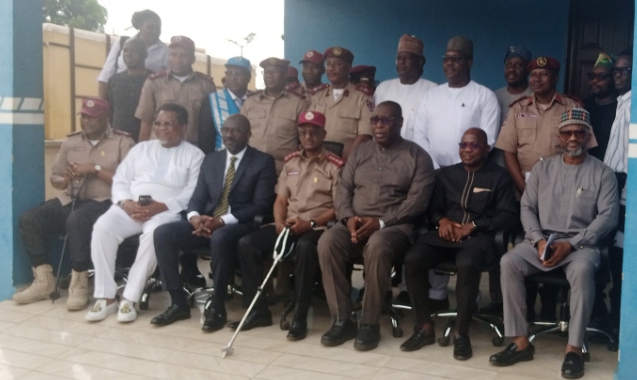
The Corps Marshal of the Federal Road Safety Corps (FRSC), Shehu Mohammed, says Safe-to-Load training for personnel is strengthening enforcement and deepening safety culture in the petroleum transport sector.
- Advertisement -

Mohammed gave the assurance on Thursday at the flag-off of the 2026 Technical Training for FRSC Desk Officers implementing the Safe-to-Load Programme at petroleum depots and terminals in Lagos.
According to him, the era of impunity on highways is over, as the Corps intensifies efforts to ensure full compliance with safety standards across the petroleum transport value chain.
“Compliance with safety regulations must be absolute and accountability must be enforced at all levels.
“I charge all participating officers and marshals to embrace this training with seriousness, dedication and commitment to excellence.
“Every inspection carried out, every standard upheld, and every intervention made should contribute directly to saving lives, protecting the environment and strengthening the integrity of the system,” he said.
The FRSC boss said road transport remains the backbone of petroleum product distribution in Nigeria, with tanker trucks accounting for more than 95 per cent of the supply chain.
He, however, noted that this mode of transport carries significant risk of catastrophic incidents if not properly regulated and controlled.
“Towards managing this unacceptable level of safety risk, the Federal Government instituted the Safe-to-Load Programme in 2015 and acceded to the 1957 United Nations Agreement on the International Carriage of Dangerous Goods by Road (ADR).
“The implementation of these interventions has continued to elevate safety standards, as reflected in the declining trend of tanker-related incidents,” he said.
Mohammed said operational reviews conducted at the end of 2025 showed significant progress in compliance and enforcement outcomes across depots and transport corridors.
“Compliance with valid class and driver licences rose to 99.4 per cent compared to 58.2 per cent at the inception of the programme in 2015.
“Installation of API-standard leak-proof systems and manhole covers reached 98.3 per cent.
“A total of 268 tanker-related crashes were recorded in 2025, while fatality and severity indices declined by 61.29 per cent and 15.53 per cent respectively compared with 2024,” he said.
He said that while these improvements were commendable, there was still need to confront recurring tragic incidents such as the Majia tanker explosion, the Dikko Junction inferno and the Indorama explosion.
According to him, the incidents underscore the importance of sustained vigilance and continuous strengthening of the road safety management system, especially in view of prevailing socio-economic challenges affecting truck operations across the country.
He described the training programme as a strategic investment in competence, professionalism and leadership development for officers charged with enforcing petroleum transport safety standards.
“Accordingly, the Corps will continue to enforce the following measures: any tanker that fails to meet Safe-to-Load requirements shall not be permitted to load under any circumstance.
“All tanker-related crashes will be subjected to thorough investigation, with responsibility extended across the entire chain, including inspecting officers, depot management, drivers and vehicle owners,” he said.
He added that tampering with speed-limiting devices or any critical safety system would attract strict enforcement actions, including prosecution, as part of efforts to deter negligence and unsafe practices.
“Operators are required to comply fully with prescribed maintenance schedules for all safety-critical components, particularly API-standard manhole covers and valves.
“The Corps will intensify monitoring through both physical inspection and the deployment of technology-driven compliance systems at depots and along transit corridors,” he added.
Mohammed also commended the leadership of the Nigerian Midstream and Downstream Petroleum Regulatory Authority for sustained inter-agency collaboration in strengthening petroleum transport safety governance.
Assistant Corps Marshal Olusegun Ogungbemide, who is in charge of operations, said the training represents a major step forward in enhancing technical capacity among inspectors responsible for petroleum tanker operations.
“Today, we are taking a bold step forward by equipping inspectors with advanced knowledge, technical skills and enforcement strategies tailored specifically to the complexities of petroleum truck operations.

“This initiative underscores our commitment to ensuring that every truck journey is conducted with the highest standards of safety, efficiency and sustainability,” he said.
—