




By Sandra Chukwunyere
The Chairman of the Maritime Media and Capacity Development Centre (MMCDC), Mr Sesan Onileimo, has urged maritime journalists to embrace Artificial Intelligence (AI) while upholding professional ethics, accuracy and accountability in news gathering and reporting.
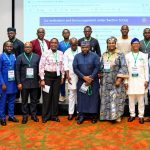
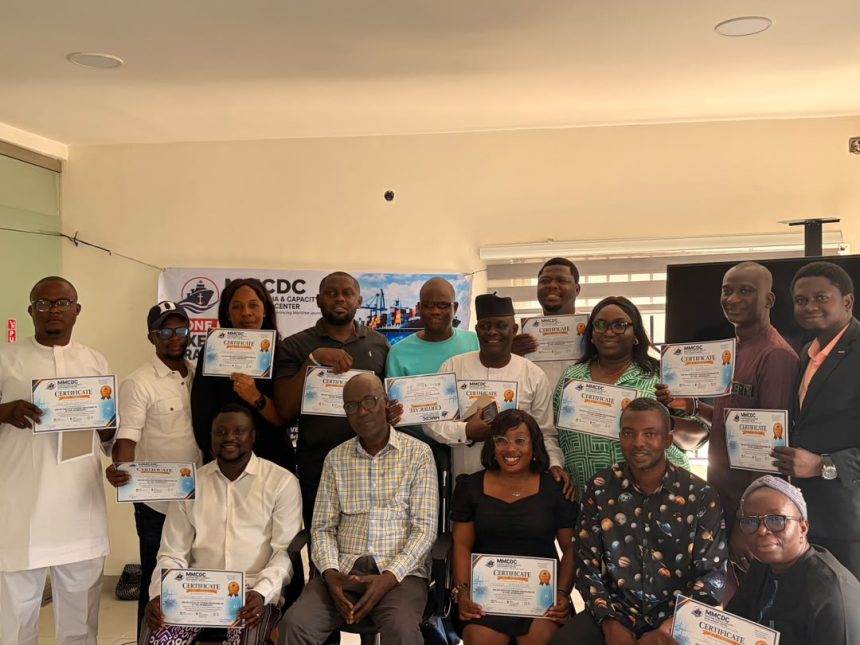
Onileimo gave the charge on Saturday, October 17, 2026, while delivering the opening address at an executive training on Artificial Intelligence for Maritime Journalists organised by the MMCDC, the capacity development arm of First Mediacon Network Limited, in Lagos.
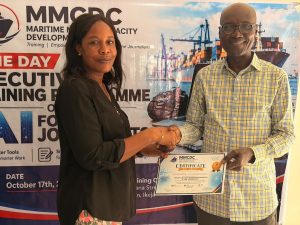
He warned that journalists could not afford to remain spectators in a technological revolution reshaping the profession, stressing the need to combine professional experience with technological competence, sound judgement and ethical responsibility.
According to him, AI offers opportunities to improve journalism through research, transcription, translation, data analysis, content development and multimedia production. However, he emphasised that journalists must verify information before publication.
“However, AI is just a tool. It is not a replacement for the journalist or journalism,” he said, noting that AI-generated information could contain errors, misleading interpretations and fabricated details.
Onileimo maintained that journalists must remain committed to truth, accuracy, fairness and accountability while using AI tools to improve their work. He explained that properly applied AI could save time, improve efficiency and allow journalists to concentrate on investigative reporting, critical analysis and public-interest journalism.
Addressing the relevance of AI to maritime journalism, the MMCDC chairman said Nigeria’s maritime industry played a strategic role in international trade, port operations, shipping, logistics, employment and economic development.
He noted that reporting these activities required specialised knowledge and the ability to interpret complex technical, regulatory and economic issues.
According to him, journalists could use AI to organise and analyse information on port performance, cargo throughput, vessel turnaround time and operational costs. However, he stressed that journalists must independently verify figures and provide the necessary context to ensure accurate reporting.
He said these capabilities could promote more analytical, evidence-based and investigative coverage of Nigeria’s maritime sector.
Onileimo cautioned journalists against relying solely on AI-generated information, emphasising the importance of official records, reliable documents and independent sources in responsible journalism.
He also highlighted ethical risks associated with AI, including misinformation, fabricated images, deepfakes, plagiarism, copyright concerns and data privacy violations. He urged journalists to confirm claims, check original sources and independently verify images, audio recordings and videos before publication.
The chairman further advised media practitioners to exercise caution when uploading confidential documents, unpublished investigations and sensitive information about their sources to AI platforms.
He stressed that journalists must retain editorial responsibility for everything they publish, warning that unverified information and unreliable sources could undermine public trust in the profession.
“Distinguished colleagues, AI must serve journalism; it must never replace our conscience, independence or responsibility to the public,” he said.
Onileimo added that every report carried the journalist’s byline and therefore required professional judgement and accountability, regardless of the technology used in its production.
Speaking on capacity development, he described continuous professional development as essential to the growth and sustainability of maritime journalism.
He called on media organisations, professional associations and training institutions to collaborate in preparing journalists for emerging technological demands. He also urged corporate organisations to partner with the MMCDC to advance professional training and capacity development in the maritime media sector.
Onileimo explained that the executive training formed part of the Corporate Social Responsibility initiatives of First Mediacon Network Limited, the centre’s parent company.
He expressed appreciation to Mr Emmanuel Maiguwa, Chief Executive Officer of Bricks Training Solution, for providing the training venue at no cost.
The chairman also commended participants for recognising the importance of continuous learning and investing their time in professional development. He appreciated his team members for their contributions to the organisation’s collective objectives and expressed confidence that the training would help build a technologically equipped, ethically responsible and professionally competitive maritime media community.

Onileimo subsequently declared open the Executive Training on Artificial Intelligence for Maritime Journalists and wished participants a rewarding learning experience.