







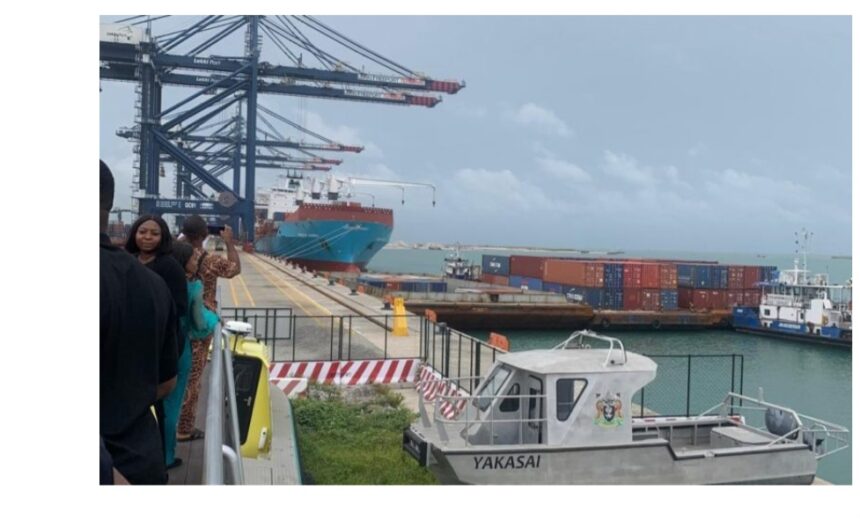
The $1.5 billion Lekki Deep Seaport has established Nigeria as a key maritime hub in the West and Central African region, following the launch of international transshipment services to ports in Togo, Benin Republic, Abidjan, and Ghana.
Since commencing commercial operations in 2023, the port has been working to increase throughput from 287,000 Twenty-foot Equivalent Units (TEUs) handled in 2024 to a projected 500,000 TEUs by the end of 2025. Despite having an installed capacity of 1.2 million TEUs, Lekki Port is currently operating at about 20 percent of its capacity.

Speaking to journalists in Lagos on Thursday, Deputy Chief Operating Officer Daniel Odibe attributed the underutilization primarily to Nigeria’s ongoing macroeconomic challenges. He cited the removal of fuel subsidies and the persistent depreciation of the naira against major foreign currencies as key factors that have led to a significant decline in import activities across Nigerian ports, including Lekki.
However, Odibe expressed optimism about the port’s recovery, noting that Lekki processed 222,000 TEUs between January and June 2025—a remarkable increase compared to the 54,289 TEUs handled in 2023, its inaugural year of operation.
“Lekki Port currently receives between 10 to 12 vessels each month,” Odibe said. “Our transshipment activities have also grown substantially. We now conduct international transshipment to Togo, Benin Republic, Ghana, Abidjan, and several landlocked countries. We are picking up because the naira is gradually stabilizing.”
- Advertisement -

Regarding operational efficiency, Odibe revealed that the current vessel turnaround time is 48 hours, while truck turnaround time averages one hour and 25 minutes. The average cargo dwell time at the port stands at 16 days.
Meanwhile, Managing Director Wang Qiang, represented by Chief Operating Officer Young Qiang, reaffirmed Lekki Port’s commitment to maintaining international standards. “We continue to raise the bar and set new benchmarks to uphold our position as West Africa’s deepest seaport,” he said.
“Our unwavering commitment to global best practices is reflected in the bold strides we are making on the African maritime trade map—through technology deployment, operational efficiency, and strategic regional engagement.”
With its strategic location and expanding transshipment services, Lekki Deep Seaport is poised to play a pivotal role in enhancing maritime trade and logistics across West and Central Africa.