






By Sandra Chukwunyere
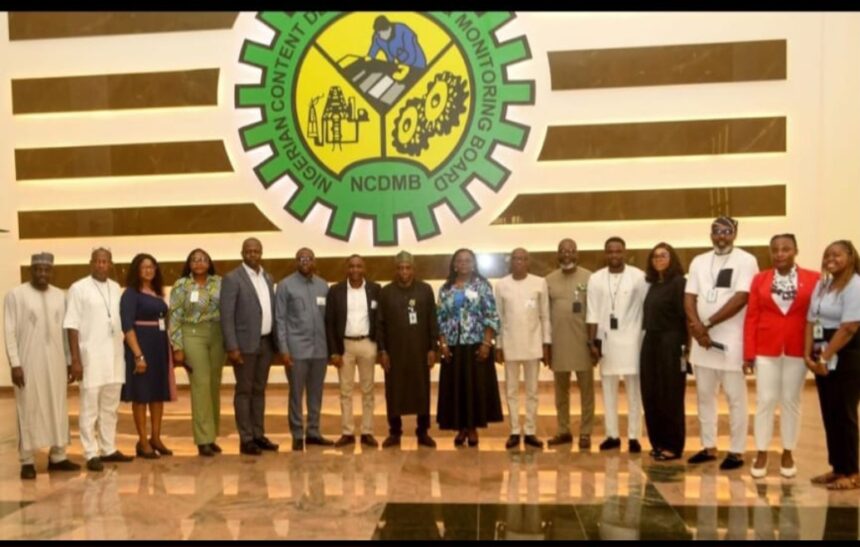
A delegation from the Ghana National Petroleum Corporation (GNPC) has visited the Nigerian Content Development and Monitoring Board (NCDMB) in Yenagoa, Bayelsa State, on a benchmarking and knowledge-sharing mission aimed at strengthening Ghana’s local content development framework.
The visit formed part of a study tour focused on understanding Nigeria’s policy structure, implementation strategies, and institutional frameworks for local participation in the oil and gas sector.
The GNPC team, led by the Director of Corporate Affairs, Mr. Eric Pwadura, was received at the Board’s headquarters by the Executive Secretary of NCDMB, Engr. Felix Omatsola Ogbe, alongside senior management officials.
Speaking during the engagement, Engr. Ogbe emphasized that Africa’s vast hydrocarbon endowment—estimated at over 120 billion barrels of crude oil and about 800 trillion standard cubic feet of gas—places responsibility on producing countries to prioritise local capacity development rather than reliance on imported expertise and technology.
He noted that strengthening indigenous participation in exploration and production remains key to economic transformation across the continent, particularly by equipping local professionals and service providers with the skills needed to compete globally.
Representing the Executive Secretary, the Director of Corporate Services, Dr. Abdulmalik Halilu, traced Nigeria’s local content journey from a policy unit within the former NNPC to the establishment of a full-fledged regulatory institution. He described the transformation as a shift “from policy to institution,” stressing that the Board remains the sole authority responsible for local content development in Nigeria’s oil and gas industry.
He further explained that the Nigerian Content 10-Year Strategic Roadmap is built on five key pillars—technical capability development, compliance enforcement, enabling business environment, organisational capacity, and market development—supported by enablers such as funding, regulation, stakeholder collaboration, and research.
A key highlight of the presentation was the Nigerian Content Intervention Fund, implemented through institutions such as the Bank of Industry and NEXIM Bank, which provides single-digit loans to indigenous companies to enhance competitiveness and expand operational capacity.
According to him, the initiative has enabled local firms to acquire critical assets, including marine vessels and other infrastructure necessary for oil and gas operations.
He also stressed that Nigeria’s local content framework is not about lowering standards but ensuring global benchmarks are met while creating opportunities for indigenous participation.
A presentation on the Board’s strategic roadmap highlighted Nigeria’s progress in increasing in-country value addition to 61 percent, reflecting steady growth in local participation across the sector.
In his remarks, Mr. Pwadura of GNPC expressed appreciation for the opportunity to learn from Nigeria’s experience, noting that Ghana’s current structure operates mainly through a local content unit, unlike Nigeria’s more institutionalised framework. He stated that Ghana seeks deeper insight into Nigeria’s model to strengthen its own systems.
Other officials of the NCDMB underscored the importance of continued collaboration among African oil-producing countries, noting that the Board has existing partnerships with regulatory counterparts in several countries, including Ghana, Senegal, Mozambique, Angola, and Namibia.
The visit, according to a statement signed by Dr. Obinna Ezeobi, Head of Corporate Communications Division, described the engagement as part of ongoing efforts to deepen regional cooperation and promote knowledge exchange in the oil and gas sector.
The statement also highlighted that both Nigeria and Ghana share a long-standing history of collaboration in energy development and continue to strengthen institutional ties through international engagements and memoranda of understanding.

The Ghanaian delegation included officials responsible for supply chain, local content development, and corporate services.